You Deserve a Schedule That Actually Works

You didn't go into hospital medicine to spend nights arguing over spreadsheets. Start by seeing your schedule clearly. Then fix what's broken.

Schedule Optimized

You went into hospital medicine to take care of patients, not to spend your nights fighting with a spreadsheet. Start by seeing your schedule clearly. Then let AI help you build a better one.

Your Group Runs on Fairness. Your Schedule Should Too.

You’ve seen what happens when one hospitalist gets stuck with back-to-back night shifts while another quietly accumulates more weekends off. The resentment builds. The complaints land on your desk. People start looking for the exit.

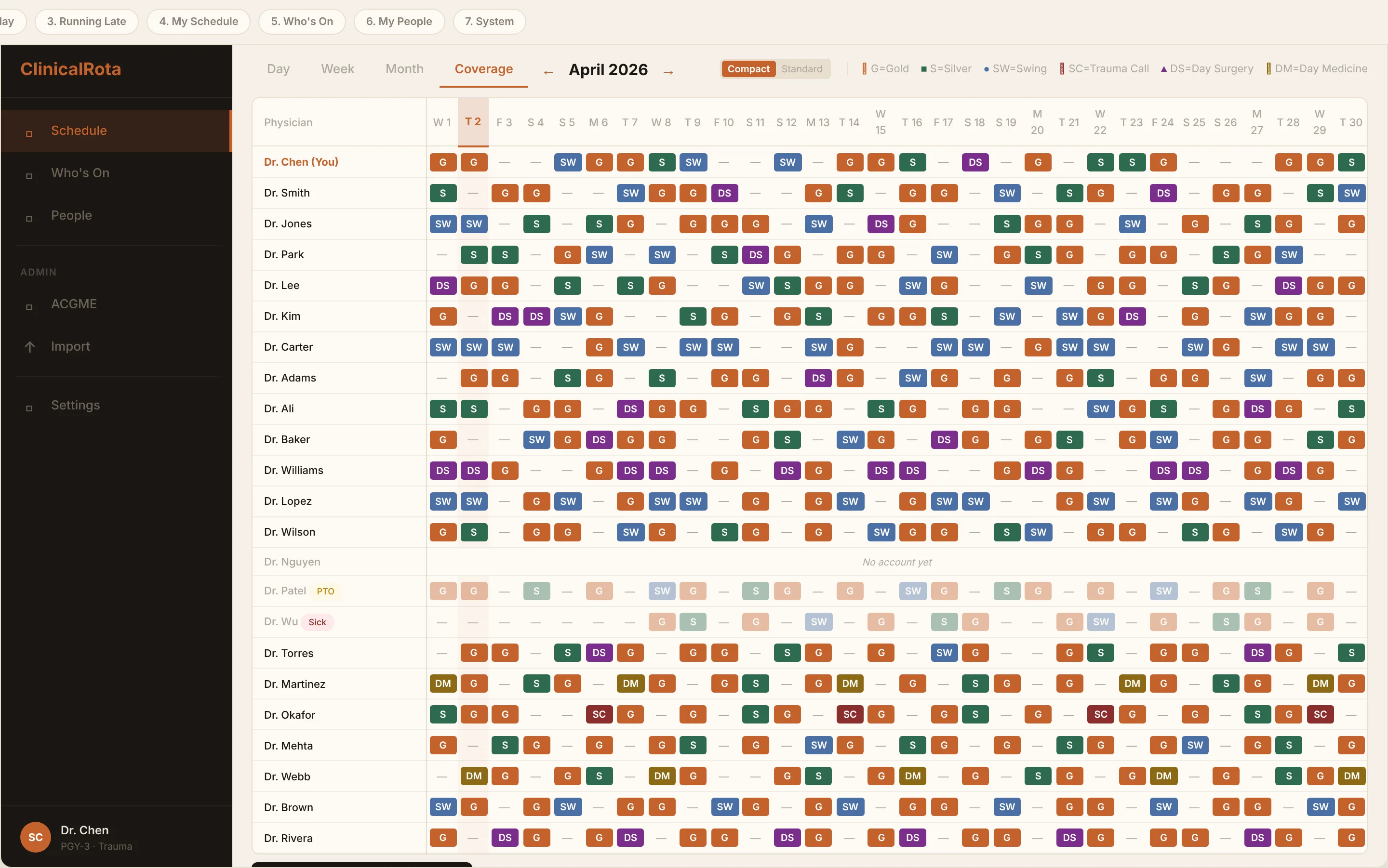
Fair scheduling isn’t a nice-to-have. It’s how you keep your group intact. But you can’t fix what you can’t see. Clinical Rota starts by making the distribution visible: who’s working what, how often, and whether the load is actually balanced.

  • See the balance in real time: A transparent dashboard shows exactly how assignments are distributed across your group
  • Prevent the slow burn: Physicians overwhelmed by lopsided schedules don’t complain first. They leave first
  • Remove yourself from the middle: When the data shows shifts are distributed objectively, you stop being the person everyone blames
  • Build trust that sticks: Your hospitalists see how assignments are made, and they see it’s objective
Your Group Runs on Fairness. Your Schedule Should Too.

Your Patients Do Better When Your Schedule Supports Continuity

You already know this intuitively. When a hospitalist follows a patient through an admission instead of handing off every 12 hours, care is better. The research backs you up: patients cared for by hospitalists on continuity-optimized schedules have significantly better 30-day outcomes, including lower mortality and readmission rates.

But building schedules that protect continuity while still being fair? That’s the part that takes hours.

  • Block scheduling that works: Configure 7-on/7-off or other models so your physicians work contiguous stretches with their patients
  • Follow patients through: Structure admissions so the same hospitalist sees a case from start to discharge
  • Fairness and continuity together: Balance both without sacrificing one for the other
  • Better outcomes, better satisfaction: Your physicians practice the medicine they trained for, not shift-based handoff medicine
Your Patients Do Better When Your Schedule Supports Continuity

You're Spending 60+ Hours on Something That Should Take Minutes

If you’re the person building your group’s schedule, you know the drill. Weeks of juggling constraints, preferences, coverage requirements, and complaints. Often on a spreadsheet that crashes if you look at it wrong.

One medical department tracked their time and found they were spending 60 to 75 hours per scheduling cycle. After switching to AI-driven scheduling, that dropped to 14 hours, freeing over 50 hours every cycle.

  • Get your time back: AI assembles complete schedules that respect staffing ratios, service coverage, and individual preferences in minutes, not weeks
  • Catch cost problems early: See when you’re about to incur avoidable overtime or need a locum fill-in before it becomes expensive
  • Fill every slot optimally: The most cost-effective allocation prevents the expensive last-minute scramble
  • Keep your physicians longer: Fair, manageable schedules reduce turnover. Replacing a single hospitalist costs $50k+. Keeping them costs nothing.
You're Spending 60+ Hours on Something That Should Take Minutes

Built for How Hospital Medicine Actually Works

You don’t need a generic scheduling tool that forces you to work around its limitations. You need one that understands hospitalist-specific realities: service rotations, ICU weeks, night float, jeopardy call.

Define your own rules: max consecutive days on service, mandatory rest after night rotations, rotation through specific units. The AI generates schedules that meet every constraint, and when reality changes, it adapts.

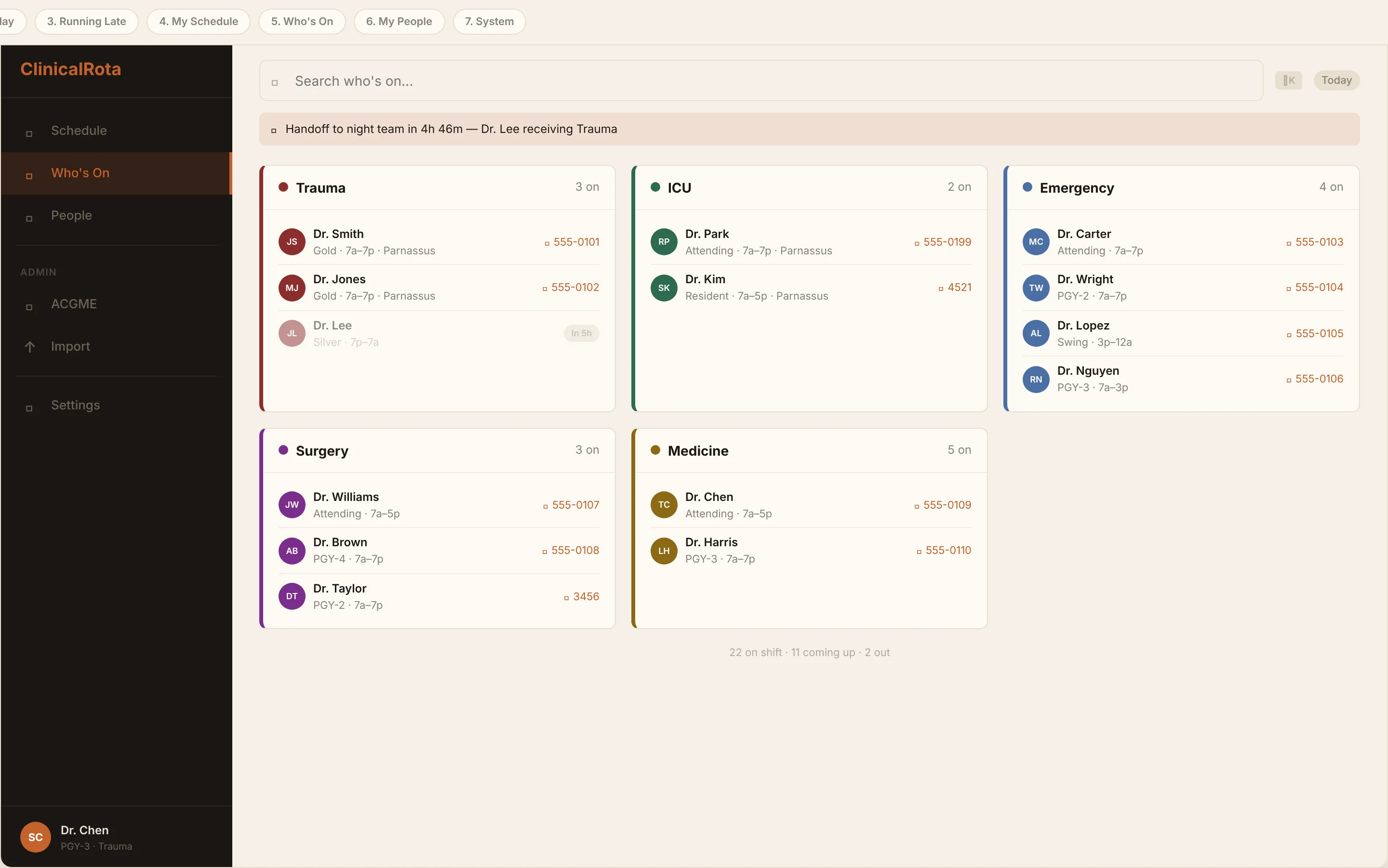
  • Handle the 4 AM call-out: When someone calls in sick, see who’s available and eligible instantly. No frantic phone tree.
  • Connect your systems: Pull PTO from your HR system, push finalized schedules to calendars or paging systems
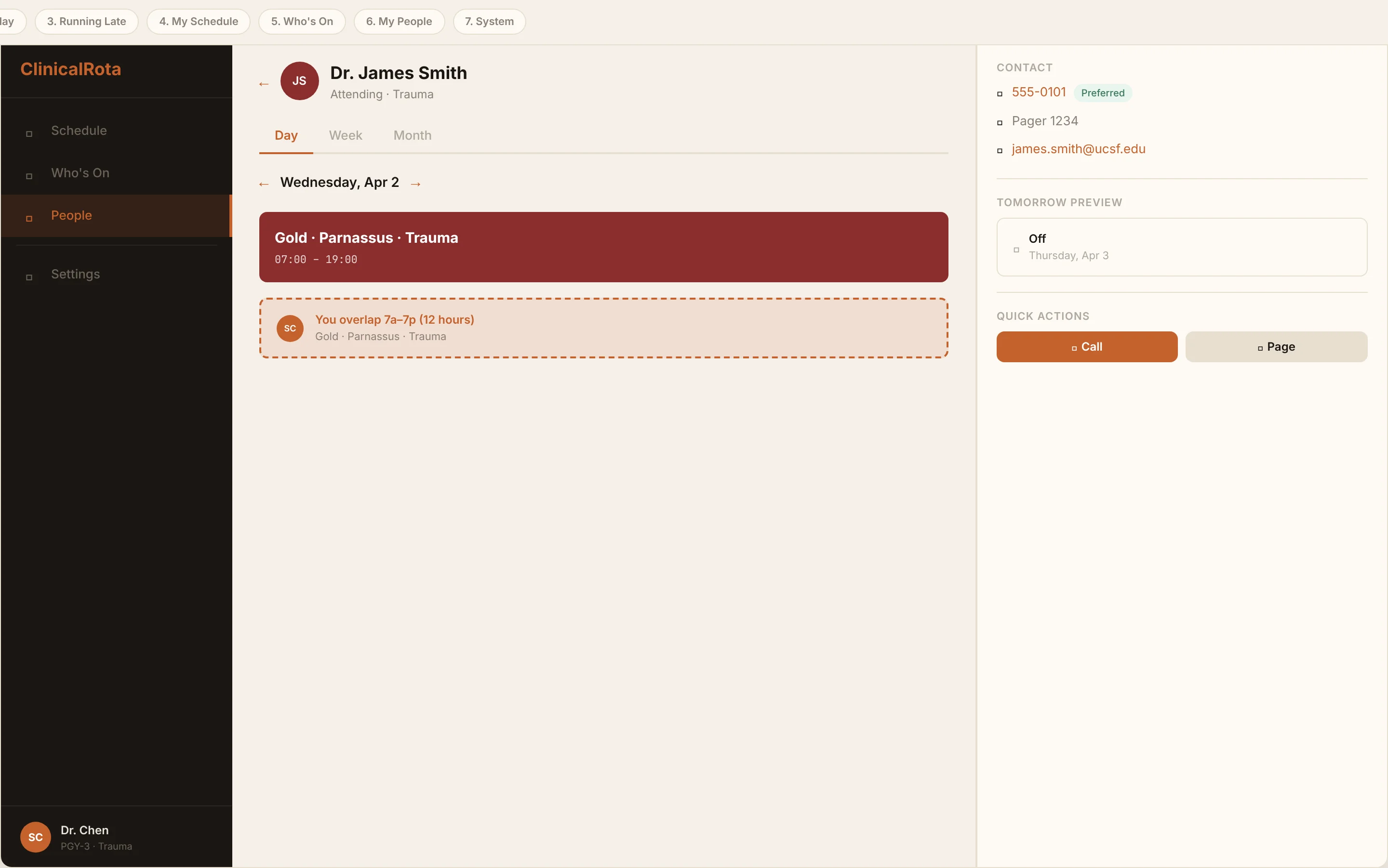
  • Transparent by default: Every physician sees their schedule, their colleagues’ schedules, and how coverage is distributed
  • Stay in control: The algorithm generates options. You make the final call. Always.
Built for How Hospital Medicine Actually Works

Key Features

Designed specifically for Hospitalists

Balanced Night & Weekend Coverage

See exactly how nights, weekends, and holidays are distributed across your group. Every hospitalist carries a fair share, and the data proves it.

Continuity of Care Scheduling

Keep your physicians with the same patients through an admission. Configure 7-on/7-off or other block models that protect both outcomes and sanity.

On-Call & Backup Management

Know immediately who's available when someone steps away. Fair on-call rotations with instant backup identification, so coverage never has a gap.

Multi-Site Coordination

If your group covers multiple hospitals or units, see it all in one place. No double-booking, no spreadsheet merging, no surprises.

Schedule Transparency

Every physician sees how shifts are assigned and why. No more "trust me, it's fair." The data is right there.

Custom Rule Configuration

Set your own guardrails. Max consecutive days, mandatory rest after nights, unit rotation sequences. The schedule follows your rules automatically.

Ready to optimize your rota?

See how AI-powered scheduling can transform your team's workflow.

Book a Demo