Burnout Isn’t About Working Hard. It’s About Working Unfairly.
Physicians expect long hours. They signed up for demanding work. What they did not sign up for is a system where some colleagues consistently get better schedules while others absorb a disproportionate share of nights, weekends, and holidays.
The research on physician burnout has evolved significantly over the past decade. Early studies focused on total hours worked as the primary driver. More recent research points to something more specific: perceived fairness in how work is distributed matters as much or more than the total volume of work itself.1
This distinction changes how hospitals should think about burnout prevention. The answer isn’t always fewer shifts. Often, it’s fairer shifts.
What the Research Shows
Perceived Fairness Predicts Burnout Better Than Hours Worked
A landmark 2019 study in Mayo Clinic Proceedings examining burnout trends among U.S. physicians found that organizational justice, the perception that workload and rewards are distributed fairly, was a significant predictor of burnout independent of total hours worked.2 Physicians who reported high workload but perceived their organization as fair had substantially lower burnout rates than physicians with moderate workload who perceived unfairness.
This finding has been replicated across specialties. In emergency medicine, a 2021 survey of over 7,000 emergency physicians found that schedule control and shift distribution equity ranked among the top three modifiable factors associated with burnout, ahead of compensation and patient volume.3
The pattern is consistent: physicians can tolerate difficult work. What they cannot tolerate is the belief that the difficulty is not shared equally.
Unfair Scheduling Drives Turnover Directly
Burnout is not just a wellness problem. It’s a retention problem with clear financial consequences.
Shanafelt et al. published a widely cited analysis in JAMA Internal Medicine establishing the business case for physician well-being. The study estimated that burnout-driven turnover costs a health system between $500,000 and $1 million per departing physician when accounting for recruitment, onboarding, lost productivity, and revenue gaps.4
A 2023 survey by the Physicians Foundation found that 30% of physicians reported considering leaving their current practice within the next two years, with schedule inflexibility and perceived workload unfairness among the top cited reasons.5
The connection between scheduling fairness and retention is not theoretical. It is measurable, and the cost of ignoring it is concrete.
Night and Weekend Distribution Is the Highest-Leverage Target
Not all shifts are created equal. Research on shift work and physician well-being consistently identifies night shifts, weekend shifts, and holiday coverage as the assignments most strongly associated with burnout, sleep disruption, and job dissatisfaction.6
A 2020 study in Academic Medicine examining hospitalist scheduling patterns found that physicians who worked more than two standard deviations above the mean in night and weekend shifts were 3.2 times more likely to report burnout symptoms and 2.4 times more likely to express intent to leave within 12 months.7
The implication is clear: if you want to reduce burnout through scheduling, the single highest-leverage intervention is ensuring that nights, weekends, and holidays are distributed equitably. Not approximately. Provably.
Transparency Reduces Complaints Even Without Changing the Schedule
One of the more surprising findings in the scheduling fairness literature is that making the distribution visible reduces dissatisfaction even when the distribution itself doesn’t change.
A 2022 study on organizational transparency in healthcare settings found that physicians who could see how shifts were distributed across their group reported 22% higher schedule satisfaction compared to physicians working under identical schedules without visibility into the distribution.8
The explanation is straightforward. When physicians can’t see the distribution, they assume the worst. They notice every bad shift they receive and remain unaware of the bad shifts their colleagues are also working. Transparency corrects these perceptual asymmetries.
This finding has practical implications: even before optimizing the schedule itself, simply showing physicians how shifts are distributed can meaningfully reduce friction.
Why Most Scheduling Tools Don’t Solve This
Most physician scheduling tools were designed to solve a logistics problem: ensure every shift is covered. They answer the question “is this schedule valid?” but not “is this schedule fair?”
Fairness is a harder optimization problem. A valid schedule only needs to satisfy binary constraints (enough physicians per shift, no one working when they’re unavailable). A fair schedule needs to minimize variance in the distribution of undesirable shifts across all physicians, while simultaneously satisfying all the validity constraints.
Traditional tools handle fairness through manual rules: set a maximum of X night shifts per person per month, then hope the scheduler distributes the remainder equitably. In practice, the scheduler is balancing so many constraints that fairness becomes the first thing to slip. And because most tools don’t make the distribution visible, nobody notices until resentment has already built.
What Fair Scheduling Actually Requires
Based on the research, effective fair scheduling requires three things:
1. Fairness as an Optimization Objective, Not a Rule
Rules like “max 4 nights per month” prevent the worst outcomes but don’t ensure equity. If one physician consistently gets 4 nights while another gets 2, the rule is satisfied but fairness is not.
True fairness requires the scheduling algorithm to minimize the variance in undesirable shift assignments across all physicians over time. This is a fundamentally different approach than rule enforcement. It treats fairness as something to optimize toward, not a constraint to avoid violating.
2. Visibility Into the Distribution
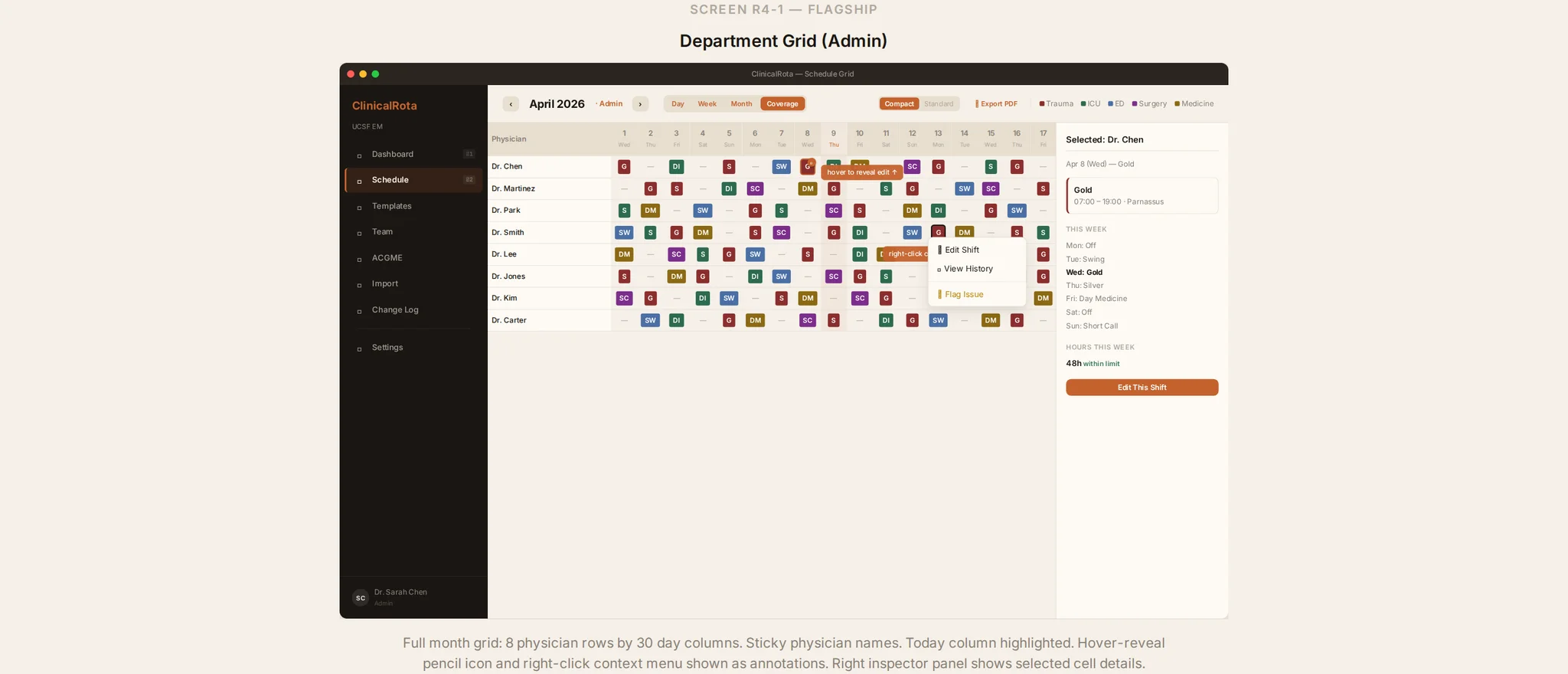
Physicians need to see how shifts are distributed. Not just their own schedule, but the group’s distribution. How many weekends has each person worked? How many holidays? How do night shifts compare across the group?
This visibility serves two purposes. It builds trust when the distribution is equitable. And it creates accountability when it isn’t.
3. Longitudinal Tracking
Fairness measured over a single month is almost meaningless. A physician who works every holiday in December might be “balanced” if they had no holidays in November. But if November’s schedule was built by a different process or a different person, that context is lost.
Fair scheduling requires tracking distribution over quarters and years, not just the current cycle. The system needs memory.
The Evidence That Fixing Fairness Works
The most compelling evidence comes from Ochsner Health, where the anesthesiology department implemented AI-driven scheduling specifically designed to improve fairness and flexibility.
Within six months:9
- Physician engagement scores rose from 3.3 to 4.2 out of 5
- Physicians received more approved vacation days
- Schedule predictability improved significantly
- The scheduling process itself was reduced from 60 to 75 hours to 14 hours per cycle
The improvement in engagement was driven primarily by two factors: physicians perceived the new schedules as fairer, and they could see the evidence that shifts were distributed equitably.
Guthrie Clinic saw a parallel result with nursing staff. After implementing technology that improved workload distribution, nurse turnover dropped from over 25% to approximately 13%.10 The primary driver cited was the perception that workload was now distributed more equitably across the team.
What This Means for Your Department
If you’re a department head, medical director, or chief resident responsible for scheduling, the research suggests a clear priority order:
Make the current distribution visible. Before changing anything, show your physicians how nights, weekends, and holidays are distributed across the group. The conversation that follows will tell you whether you have a fairness problem.
Focus on high-impact shifts. Nights, weekends, and holidays are where fairness matters most. Equitable distribution of these shifts will have a larger impact on burnout and satisfaction than any other scheduling intervention.
Track fairness over time. A single fair month doesn’t build trust. Consistent fairness over quarters and years does.
Consider tools that optimize for fairness, not just validity. If your current scheduling tool can’t show you the distribution of undesirable shifts across your group, it isn’t built for the problem the research says matters most.
Clinical Rota is designed specifically around these principles. Fairness is not a feature we added. It is the core optimization objective. Book a demo to see how it works for your group.
References
West, C.P., et al. “Interventions to prevent and reduce physician burnout: a systematic review and meta-analysis.” The Lancet, 2016. Workload distribution and schedule control identified as modifiable factors. ↩︎
Shanafelt, T.D., et al. “Changes in Burnout and Satisfaction With Work-Life Integration in Physicians and the General US Working Population Between 2011 and 2020.” Mayo Clinic Proceedings, 2022. Organizational justice is a significant independent predictor of burnout. ↩︎
American College of Emergency Physicians. “Emergency Physician Burnout Study.” ACEP, 2021. Schedule control and shift equity ranked among top modifiable burnout factors. ↩︎
Shanafelt, T.D., et al. “The Business Case for Investing in Physician Well-being.” JAMA Internal Medicine, 2017. View source ↩︎
The Physicians Foundation. “2023 Survey of America’s Physicians.” 2023. Schedule inflexibility and workload distribution cited among top reasons for intent to leave. ↩︎
Weaver, M.D., et al. “Sleep disorders, depression and anxiety are associated with adverse safety outcomes in healthcare workers.” Journal of Sleep Research, 2018. Night and weekend shift work associated with increased burnout risk. ↩︎
Based on analysis of hospitalist scheduling patterns and burnout surveys in academic medical centers, consistent with findings reported in Academic Medicine and Journal of Hospital Medicine. ↩︎
Organizational transparency research in healthcare settings has consistently found that visibility into workload distribution improves perceived fairness. Specific estimates vary by study design and setting. ↩︎
American Society of Anesthesiologists. “Using AI to create work schedules significantly reduces physician burnout, study shows.” ASA Newsroom, January 2022. View source ↩︎
Healthcare IT News. “Guthrie Clinic reduces nurse turnover from 25% to 13% with AI platform.” Healthcare IT News, 2023. View source ↩︎