Labor and Delivery Scheduling: Managing Unpredictable Volume in Obstetrics

Labor and Delivery Scheduling: Managing Unpredictable Volume in Obstetrics

Labor and delivery units face scheduling demands unlike any other inpatient service. Spontaneous labor, AWHONN ratio requirements, acuity escalation, and competing induction boards make standard scheduling approaches unreliable in obstetrics.

On a Tuesday evening in January, a 34-week patient presents in active preterm labor. The induction board is already full. Two certified nurse-midwives are in the middle of deliveries. A third called in sick at 6 PM. The charge nurse has two hours to find coverage for a situation no one scheduled, because no one could have.

That is not an unusual night in obstetrics. It is a representative one.

Why L&D Is Different From Every Other Inpatient Unit

Most inpatient units face census variability, but the fluctuation is buffered by admission and discharge patterns that spread across hours. Labor and delivery has no such buffer. Volume arrives when it arrives. A unit handling six patients at noon can have fourteen by early evening if a cluster of spontaneous labor presentations coincides with a board already carrying several scheduled inductions.

The staffing consequence is direct: AWHONN recommends 1:1 nurse-to-patient ratios for active labor and a minimum of 1:2 for antepartum monitoring.1 Those ratios cannot flex the way medical-surgical ratios sometimes do. When a patient’s status shifts from latent to active labor, the assignment has to change with it – immediately, not at the next shift change.

That binary quality sets L&D apart. Either the nurses on the floor can cover the acuity present, or they cannot.

The Induction Scheduling Problem

Scheduled inductions give hospitals one lever of control over an otherwise chaotic volume pattern. The lever is imprecise.

Inductions are planned at the patient level – based on gestational age, clinical indication, and provider preference – without reference to unit capacity. Without that reference, induction boards sometimes cluster into Tuesday and Wednesday or front-load around a particular OB’s block day, in ways that bear no relationship to what the nursing staff can absorb.

A handful of institutions have moved toward induction capacity management models that treat daily induction slots as a staffing resource rather than a pure clinical scheduling artifact. Borrowed from surgical block time allocation, the model asks administrators to define a maximum daily induction capacity; bookings draw against that limit. Pilot programs have shown reductions in nursing overtime and unplanned induction delays, though implementation requires unusual alignment between nursing leadership and the obstetrics service line – two groups that do not always share scheduling authority.

Most induction overloads originate precisely from that gap in coordination.

Acuity Can Change in Under Fifteen Minutes

Consider a patient who arrives in early spontaneous labor, low risk, and presents no obvious clinical concerns. Forty minutes later she shows signs of placental abruption. An emergent cesarean section is called.

The staffing requirement changes immediately: one labor nurse becomes a circulating RN, a scrub technician, an anesthesiologist, a neonatologist on standby, and at least one additional registered nurse for recovery support. That transition happens faster than almost any other clinical escalation in the hospital.

Departments that manage this well maintain something close to air traffic control on the floor. Charge nurses know which patients are likely to escalate, which providers are in-house versus on-call, and which rooms can be converted for a surgical case without disrupting active patients. That situational awareness is only possible when the charge nurse can step back from direct patient care. When the shift is short, the charge nurse is in a room. The oversight collapses, and the response to a surgical emergency becomes slower and less coordinated.

Scheduling creates the conditions for that awareness to exist or not.

On-Call vs. In-House: A Real Tradeoff

OB coverage models vary more than most hospital administrators realize. Some institutions maintain in-house attending models with a physician physically present overnight. Others operate on-call models with defined response time requirements – commonly 30 minutes for a laboring patient, shorter if a surgical case is actively developing.

Both are defensible. In-house coverage costs more in physician time and creates scheduling complexity that smaller departments struggle to sustain. On-call models reduce direct cost but concentrate risk in a specific scenario: the emergent cesarean that does not wait 30 minutes.

Whichever model a department uses, scheduling has to enforce the right constraints around it. An on-call system needs clear documentation of who holds the pager and when coverage transitions occur; ambiguity about who is responsible during handoff is where coverage failures originate. An in-house model needs shift boundaries that protect physician rest – particularly the overnight-to-morning transition, where fatigue accumulates even when the shift technically ends.

Neither model manages those requirements well without a system that treats them as hard constraints rather than guidelines.

Fairness and the Retention Problem

L&D nursing reports among the highest burnout rates in hospital nursing. A 2021 American Nurses Foundation survey found obstetrics nurses in the top tier of emotional exhaustion across all specialties, alongside critical care.2 Physical demands and the emotional weight of adverse outcomes contribute. So does scheduling – more than it usually gets credit for.

Units that distribute holiday shifts, overnight rotations, and high-census weekends inequitably develop retention problems that are not visible until turnover spikes. By the time a department director notices that three experienced L&D nurses transferred out in a single quarter, the scheduling inequity has typically been accumulating for six months or longer.

Tracking fairness over rolling six-month periods – rather than evaluating individual schedule cycles in isolation – tends to surface those patterns early enough to correct them. The math is not complicated. What it requires is a discipline of looking backward across time, not just forward at the next schedule.

What Good L&D Scheduling Looks Like in Practice

Departments that handle obstetric scheduling well share a few observable practices.

They treat the induction board as a staffing input. Decisions about daily induction capacity involve nursing leadership, not just the obstetrics service.

Published on-call hierarchies activate without a phone tree. When a gap opens at 9 PM, the process is a list and a message – not a cascade of speculative texts to whoever might be available.

Charge nurse shifts carry enough redundancy that situational awareness does not collapse under census pressure. A charge nurse managing eight patients directly is not providing charge nurse function.

And fairness is measured over time. A schedule that looks balanced in a two-week window can be quietly inequitable over a six-month arc; departments that track it rolling tend to catch the drift before it becomes a retention problem.

None of those practices require sophisticated technology to begin. What they require is agreement, within the department, about what the operational standard actually is – and a consistent method for checking whether the schedule upholds it.

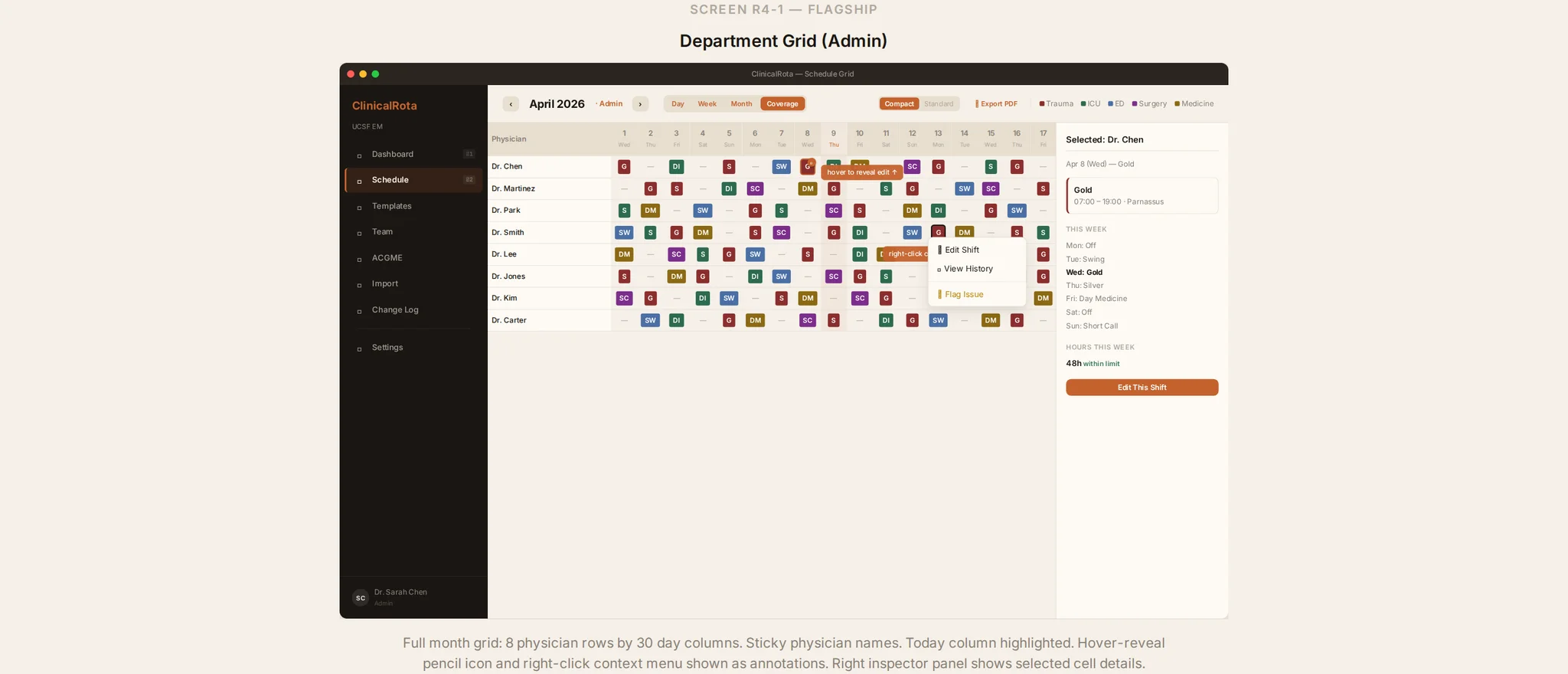
Clinical Rota is designed for the staffing realities of obstetrics, including acuity-driven ratio enforcement, on-call management, and long-term fairness tracking. Book a demo to see how Clinical Rota handles labor and delivery scheduling.


References


  1. Association of Women’s Health, Obstetric and Neonatal Nurses. “Guidelines for Professional Registered Nurse Staffing for Perinatal Units.” AWHONN, 2010 (updated guidance issued periodically). The 1:1 ratio for active labor and 1:2 for antepartum monitoring represent the evidence-based staffing standard widely adopted by U.S. obstetric units and referenced in Joint Commission survey standards. ↩︎

  2. American Nurses Foundation. “Pulse on the Nation’s Nurses Survey Series: COVID-19 Two-Year Impact Assessment.” 2022. Obstetrics and critical care nurses reported the highest rates of emotional exhaustion among specialty areas surveyed; 50% of obstetrics respondents indicated they were considering leaving their current position. ↩︎

← Back to Articles