The Hidden Cost of Healthcare Scheduling, And How Modern Tools Are Fixing It

The Hidden Cost of Healthcare Scheduling, And How Modern Tools Are Fixing It

Hospital scheduling consumes 800+ hours a year and drives clinician burnout. Learn why traditional methods fail and what a modern scheduling workflow looks like.

The Hidden Cost of Healthcare Scheduling

Creating a full year schedule for a hospital department is often a massive undertaking. Manually assembling physician schedules via spreadsheets can consume roughly 800 hours per year, about three months of work. An administrator must juggle complex constraints (call rotations, weekend coverage, holidays, individual requests) using spreadsheets and sticky notes. By the time the schedule is finally published, it is frequently outdated, as inevitable changes and conflicts require constant rework. And once a schedule is set, making mid-course changes is extraordinarily difficult with manual methods.

The consequences are personal. Hospitalists miss family events because their shifts were set in stone months in advance. Nurses resort to trading shifts via long text message chains, introducing confusion and potential errors. Administrators spend evenings and weekends resolving last-minute conflicts when they could be resting or spending time with family. These are not edge cases. They are the norm in healthcare scheduling.

This is not just an inconvenience; it is a systemic drain. Every hour a clinician or administrator spends wrestling with a schedule is an hour not spent on patient care. Rigid, inflexible schedules also contribute to staff burnout. Studies have shown that excessive administrative workload and limited control over work schedules increase stress and lead to physician burnout. An unfair or unaccommodating schedule saps morale and can drive talented clinicians out of the profession. The burden falls on everyone: schedulers who devote weeks to a task that should take hours, and clinical staff who feel trapped by schedules they had little say in creating.

Why Traditional Scheduling Falls Short

Most hospitals still rely on some combination of Excel spreadsheets, email chains, and institutional memory to coordinate the most complex workforce in the world. These ad-hoc systems have quietly become an invisible force driving burnout, compliance risks, and unnecessary costs. The core problem is that manual methods simply cannot keep pace with the number of variables involved.

A typical hospital schedule must account for credentialing requirements, labor law compliance, shift equity across dozens of providers, vacation requests, on-call rotations, multi-site coverage, and real-time changes like sick calls, all simultaneously. Spreadsheets can store this information, but they cannot reason about it. Every time a single variable changes, the entire puzzle has to be reassembled by hand. The result is a process that is slow, error-prone, and deeply frustrating for everyone involved.

The downstream effects are measurable. Departments that schedule manually report higher overtime costs, more reliance on expensive agency staff, and lower provider satisfaction scores. When clinicians feel the schedule is unfair or inflexible, engagement drops and turnover rises, creating a vicious cycle where the remaining staff shoulder even heavier loads.

What Modern Scheduling Looks Like

A new generation of scheduling tools is replacing the spreadsheet-and-email approach with intelligent automation. While implementations vary, the most effective platforms share a common set of capabilities:

  • Rules defined once, applied everywhere. Every hospital has unique staffing rules and coverage requirements. Modern platforms let you encode constraints (number of providers per shift, rotation patterns, weekend and night duty policies, credential requirements, labor regulations) once, so the system enforces them automatically. No more cross-checking every assignment by hand.

  • Staff input built into the workflow. Instead of paper forms or email threads, providers submit preferences and time-off requests through an online interface. Mobile-friendly access means this takes seconds, not days of chasing people down. Gathering input digitally and early gives staff a voice in the process and creates a centralized record of everyone’s constraints.

  • AI-generated schedules in seconds. Algorithms evaluate thousands of possible combinations to produce an optimized schedule in seconds rather than weeks. Difficult shifts like nights, weekends, and holidays are distributed equitably so no single clinician is overburdened. The result is a schedule that meets coverage requirements while being perceived as fair by the team.

  • Real-time adaptability. Healthcare is dynamic. When someone calls in sick or a late conflict arises, the system can instantly suggest a qualified replacement, eliminating frantic phone calls and email chains. Updates are pushed in real time so everyone always sees the latest version. Scheduling becomes a living process rather than a static document.

These capabilities are not theoretical. Ochsner Health’s anesthesiology department reported cutting its scheduling process from 60 to 75 hours down to 14 hours after adopting AI scheduling, while engagement scores among physicians rose from 3.3 to 4.2 out of 5 within six months. Healthcare organizations commonly report 70 to 80 percent reductions in time spent on scheduling administrative tasks after implementation.

What to Look For When Evaluating Scheduling Tools

If you are considering a move away from manual scheduling, here are the criteria that matter most:

  • Constraint handling. The tool should support the full complexity of your scheduling rules, not just basic shift assignments, but multi-site coverage, credential matching, fatigue limits, and equitable distribution of undesirable shifts. If you have to work around the tool, it will create more problems than it solves.

  • Provider experience. The best scheduling system in the world fails if clinicians do not use it. Look for intuitive self-service interfaces where providers can submit preferences, request swaps, and view their schedules from any device. Adoption depends on the tool feeling empowering rather than imposed.

  • Adaptability. A schedule is only useful until the first sick call. The platform should handle real-time changes gracefully: identifying available qualified staff, respecting the same fairness rules as the original plan, and notifying affected parties automatically.

  • Transparency and fairness. Staff trust erodes quickly if they cannot understand why they got the shifts they did. Look for tools that make their logic auditable and allow you to set explicit fairness constraints (for example, maximum night shifts per person per month).

  • Integration. The tool should work with your existing systems (EHR, HR, credentialing) rather than requiring you to maintain parallel data. Clean data integration is the foundation of accurate scheduling.

The Payoff: Healthcare That Focuses on Care

Scheduling will always be a necessary part of healthcare operations, but it should not consume the time and energy of those who deliver care. When scheduling works well, when it is fast, fair, and flexible, the benefits compound across the organization.

Providers gain a better work-life balance and a sense of autonomy over their schedules. Administrators reclaim hundreds of hours to invest in clinical leadership and staff development. Patients receive care from teams that are properly staffed and less stressed. The evidence is clear: when you get provider scheduling right, your organization is better positioned to deliver exceptional care while supporting clinician well-being.

The shift from manual to intelligent scheduling is not a question of if, but when. The tools exist today. The question for hospital administrators and clinical operations leaders is whether the current cost, in hours, in dollars, in clinician well-being, is one worth continuing to pay.

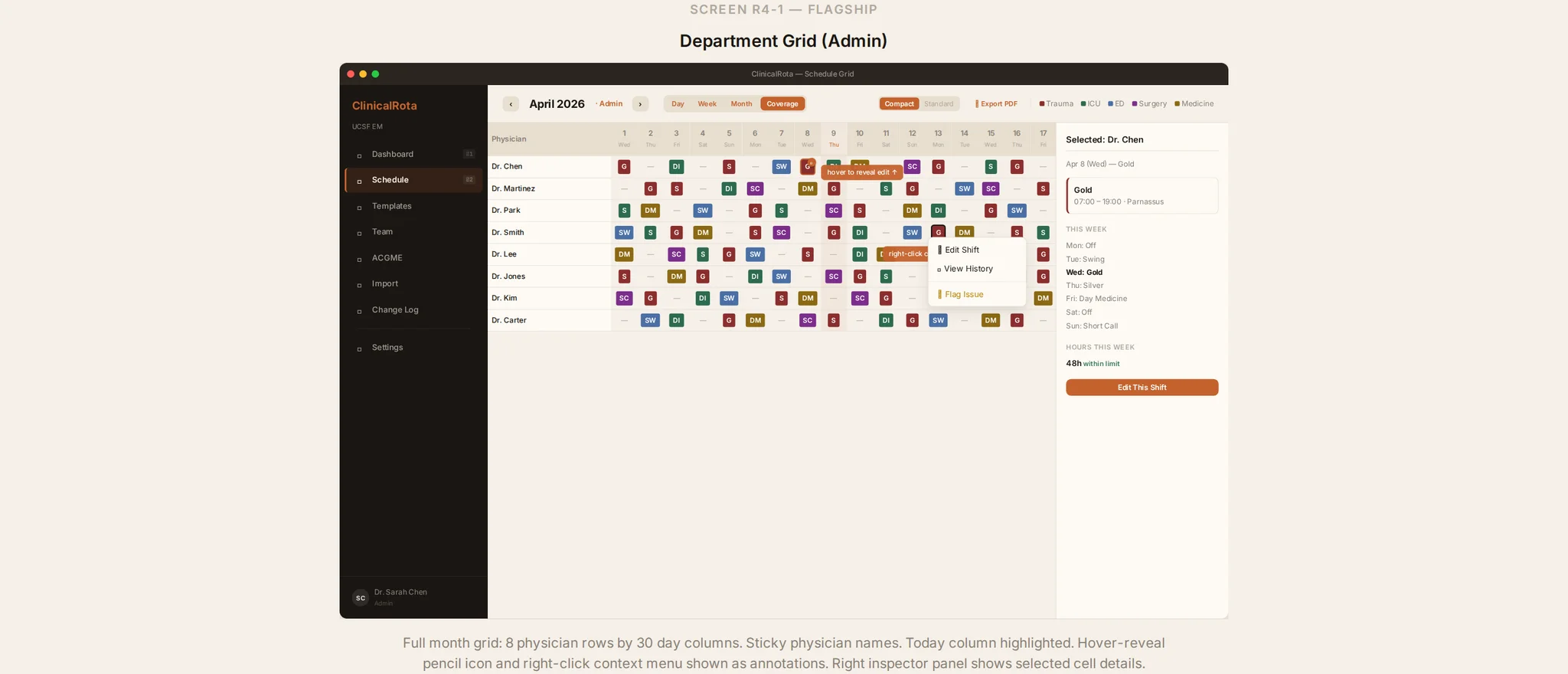
Clinical Rota is one platform built specifically for this problem: turning months of manual scheduling work into seconds of AI-powered automation, with fairness and flexibility at its core. If your team is ready to make the shift, book a demo to see it in action.

← Back to Articles