Four Tools, Four Different Starting Points
If you run physician scheduling for a hospital department, you are probably using one of four approaches:
- A spreadsheet somebody built five years ago
- Amion, the lookup tool that answers “Am I on?”
- QGenda, the enterprise scheduling platform
- Nothing yet (you are still looking)
Each solves a different problem. This article compares them honestly so you can figure out which one fits where your department actually hurts.
Spreadsheets: The Default Nobody Chose
Most departments did not pick Excel or Google Sheets as their scheduling platform. Someone built a template, it worked well enough, and now the whole department depends on a file that one person understands.
| What spreadsheets do well | Where they break down |
|---|---|
| Free and flexible | No constraint enforcement: a formula can count shifts, but it can’t prevent scheduling a physician who just finished a night rotation |
| Familiar to everyone | No adaptability: every change is manual, and every manual change risks breaking something else |
| Easy to get started | Single point of failure: if the scheduler is on vacation, nobody else can update the sheet |
| No mobile access: physicians check a static file on a desktop or wait for an email |
Healthcare organizations commonly report spending 60 to 75 hours per scheduling cycle on manual methods.1 That is not scheduling. That is a part-time job.
Amion: The Workhorse That Shows Its Age
Amion (“Am I On?”) has been a fixture in academic medical centers and residency programs for over two decades. It does one thing well: publish a schedule and let physicians check whether they are working.
| What Amion does well | Where it struggles |
|---|---|
| Simple, fast lookup for “am I working today?” | Schedule creation happens outside the tool. Amion is a viewer and publisher, not a scheduler. Someone still builds the rota in a spreadsheet and uploads it2 |
| Widely adopted in residency programs | Minimal mobile experience: the interface was designed for desktop browsers in the early 2000s |
| Low cost | No optimization or constraint violation alerts |
| No real-time change notifications: physicians check on their own |
For departments that just need a place to post a finished schedule, Amion works. But it has not meaningfully changed in years, and the expectations of physicians have.
QGenda: The Enterprise Platform
QGenda is the largest dedicated physician scheduling platform in the U.S. It offers automated schedule generation, time-off management, on-call tracking, and workforce analytics.
| What QGenda does well | Where it gets pushback |
|---|---|
| Mature automation engine with rule-based schedule generation | Complexity: the breadth means a steep learning curve, and departments often need dedicated training and ongoing configuration support3 |
| Broad feature set covering scheduling, credentialing, and workforce management | Cost: enterprise pricing puts QGenda out of reach for smaller departments and community hospitals |
| Enterprise integrations with Epic, Cerner, and other EHR systems | Physician experience: the platform is optimized for administrators, and physicians often report the interface feels like it was designed for the person building the schedule, not the person living with it4 |
| Large customer base and established track record | Implementation timeline: getting fully configured can take months |
QGenda is a capable tool for large health systems with dedicated scheduling staff. For departments looking for something simpler, faster, or more physician-focused, it can feel like overkill.
Where Clinical Rota Fits
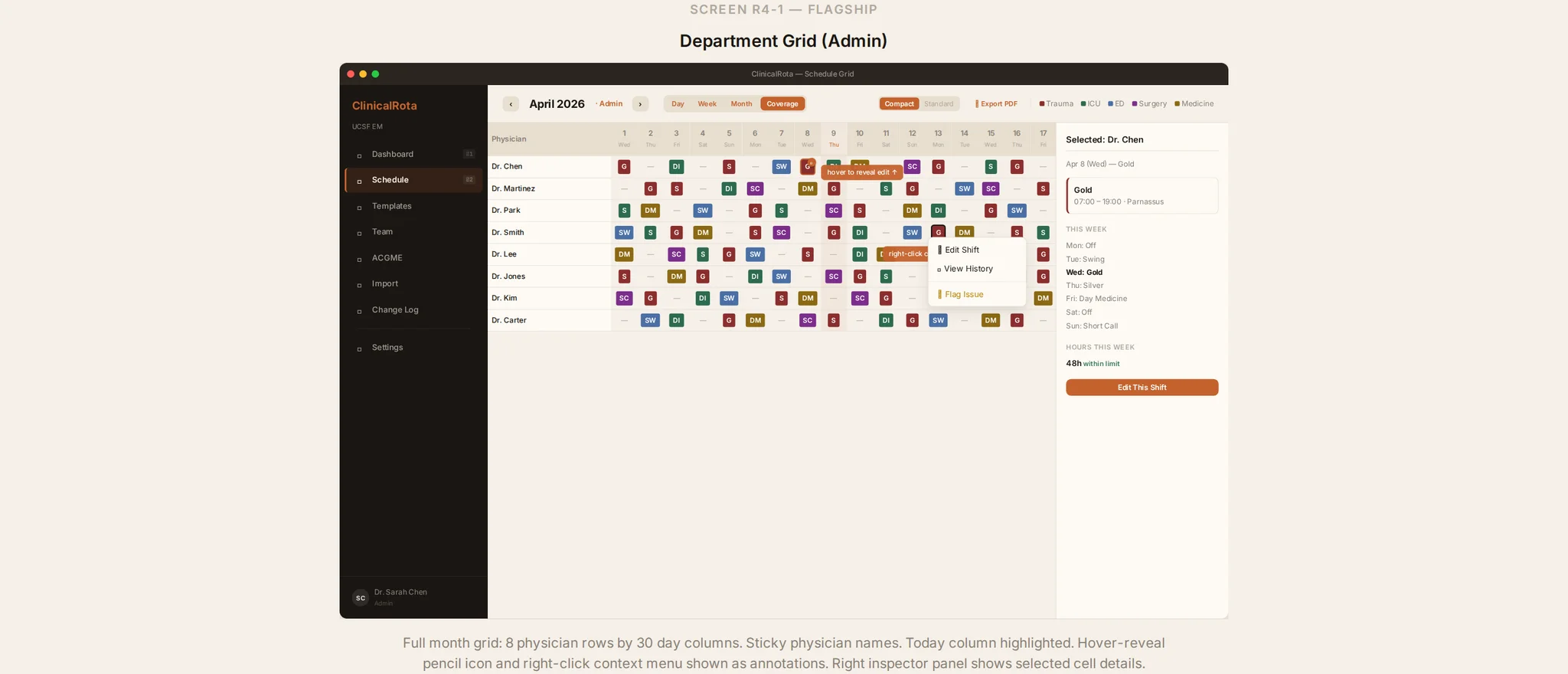
Clinical Rota starts from a different place than the tools above. We asked one question first: Can physicians actually see and understand their schedule?
Phase 1: A better schedule viewer (available now)
Clinical Rota launches as a schedule viewer, the same core job that Amion does. But it does that job for 2026, not 2002.
| Capability | Amion | Clinical Rota (Phase 1) |
|---|---|---|
| View today’s schedule | Yes | Yes |
| Mobile-first design | No (desktop-era UI) | Yes (built for phones and tablets) |
| Know who is on right now | Basic list | Rich “Who’s On” view with search |
| Dark mode | No | Yes |
| Real-time schedule change alerts | No | Yes |
| View colleague schedules | Limited | Full directory with day/week/month views |
| See shift distribution across the group | No | Yes |
If your department uses Amion today, Clinical Rota gives your physicians a better experience for the same core task: knowing what their schedule is, who else is working, and what the overall picture looks like.
Future phases: schedule generation and management
Schedule generation, shift swaps, time-off requests, and administrative tools are on the roadmap. We are building in phases rather than shipping everything at once, because getting the viewing and transparency layer right is the foundation everything else depends on.
What Clinical Rota does differently at every phase
- Physician-first design. The schedule view is built for the people who live with the schedule, not just the people who build it
- Transparency by default. Physicians see their assignments, their colleagues’ assignments, and how shifts are distributed across the group
- Modern experience. Mobile-first, dark mode, real-time alerts, instant search. The basics that physicians expect from every other app they use
Where Clinical Rota is still early
We are honest about where we are:
- We do not yet generate schedules (that is a future phase)
- We do not yet have the breadth of integrations that QGenda offers
- We do not have two decades of deployment history like Amion
- We are focused on doing the viewing and transparency job exceptionally well first
Full Comparison
| Dimension | Spreadsheets | Amion | QGenda | Clinical Rota |
|---|---|---|---|---|
| Primary job | Build schedule manually | View published schedule | Build + view + manage | View schedule with transparency (Phase 1); build + view + manage (future) |
| Schedule creation | Manual | Manual (external) | Rule-based automation | Roadmap (AI optimization) |
| Schedule viewing | Open the file | Desktop-era web UI | Admin-focused portal | Modern, mobile-first, physician-first |
| Mobile experience | Poor | Poor | Functional | Native-quality (phone, tablet, desktop) |
| Real-time alerts | None | None | Yes | Yes |
| Learning curve | Low | Low | High | Low |
| Cost | Free | Low | Enterprise pricing | Competitive |
| Integration depth | None | Limited | Extensive | Growing |
| Best for | Tiny groups with no budget | Departments that just need a place to post a schedule | Large health systems with dedicated scheduling staff | Departments that want a modern physician experience with schedule transparency |
How to Decide
The right tool depends on where your pain is.
Stay on spreadsheets if your group is small, your constraints are simple, and nobody is asking for a better way to view the schedule.
Stay on Amion if you only need a place to post a finished schedule and your physicians do not care about mobile access or real-time notifications. But if your residents or attendings are asking for a better experience, Amion is not going to evolve to give it to them.
Choose QGenda if you need enterprise-grade workforce management across dozens of departments with deep EHR integration and you have the budget and staff to configure it.
Choose Clinical Rota if you want a modern, physician-first schedule viewer with AI-powered schedule generation coming in future phases. If your department currently uses Amion and your physicians want something better, this is the most direct upgrade.
Book a demo to see how Clinical Rota works for your department.
References
American Society of Anesthesiologists. “Using AI to create work schedules significantly reduces physician burnout, study shows.” ASA Newsroom, January 2022. View source ↩︎
Amion.com documentation and user forums describe Amion as primarily a schedule viewing and communication tool, with schedule creation typically performed in external applications. ↩︎
KLAS Research. “Physician Scheduling 2023: Which Vendors Deliver?” KLAS, 2023. Customer feedback notes implementation complexity as a common concern for larger platforms. ↩︎
Based on physician feedback gathered during Clinical Rota’s design research with emergency medicine residents and hospitalists at academic medical centers. ↩︎